What are vegetation types? |
‘Vegetation types’ are abstract entities into which real-world vegetation is classified in order to facilitate communication and analysis. The basis of most classifications is a set of characteristics: usually some combination of (a) physiognomy (overall appearance), (b) species composition, (c) traits of the constituent species (such as bark thickness, or leaf size, life-span or succulence), or (d) environment (such as climate, soil, topography, and disturbance regime). One might imagine that such a classification yields units that are distinct from each other and homogeneous within. However, vegetation type classifications are externally imposed–while they provide us useful nomenclature and succinct descriptions that are broadly applicable, nature itself varies rather more continuously. |
Our evolving understanding of vegetation structure and change |
|
Our current understanding of the drivers of vegetation allows us to broadly predict where a species you find this book might occur, or, conversely, what kind of species we might expect to see at a given location. Plants tend to be taller and larger-seeded in warmer locations provided there is adequate water, and thus warm and wet locations support tall forests while drier and/or colder (high latitudes and high elevations) locations support shorter-statured vegetation (Joswig et al. 2022; Jucker et al. 2025). Wide crowned trees tend to come from drier locations (Jucker et al. 2025). Leaves tend to be larger-sized where it is hot and sunny and there is plenty of water, and thicker and/or succulent where it is hot and sunny but water is scarce (Wright et al. 2017; Joswig et al. 2022; de Freitas et al. 2024). Leaf size also decreases as we move away from the equator toward the poles (Wright et al. 2017). Plants are more likely to have pubescent leaves in warm, sunny places (Moles et al. 2020; Wang et al. 2022). The prevalence of needle-leaved species increases in locations having cold winters or extended dry seasons; the converse is true for broadleaved species (Ma et al. 2023). The tendency to be evergreen—i.e., retain a leafy canopy through most of the year—increases on infertile, acidic soils, while the tendency to be deciduous—i.e., shed leaves seasonally—increases where seasonal drought or frost occurs (Givnish 2002; Ma et al. 2023). Species with thick bark tend to be found in fire-prone locations with high precipitation seasonality (Pellegrini et al. 2017). |
Biotic factors—including humans—influence the trait and species distributions in important ways as well. The prevalence of spines, thorns, and prickles is more strongly associated with open vegetation types such as savanna, thorn forest and scrub, which have higher densities of mammalian herbivores, than with closed vegetation types such as evergreen forest (Ratnam et al. 2016; Charles-Dominique et al. 2016). Tree cover tends to increase with slope because human impact is greatest on relatively flat terrain (Sandel and Svenning 2013). As a consequence, relatively intact forest and protected areas tend to be found at higher elevations, on rugged terrain, and in locations otherwise unfavoured for agriculture and other uses (Loucks et al. 2008). Humans have also moved plant species, especially useful or attractive ones, around the globe at an unprecedented scale. Many such species have become invasive, and have significantly altered the composition of plant communities throughout India. |
Vegetation types of India |
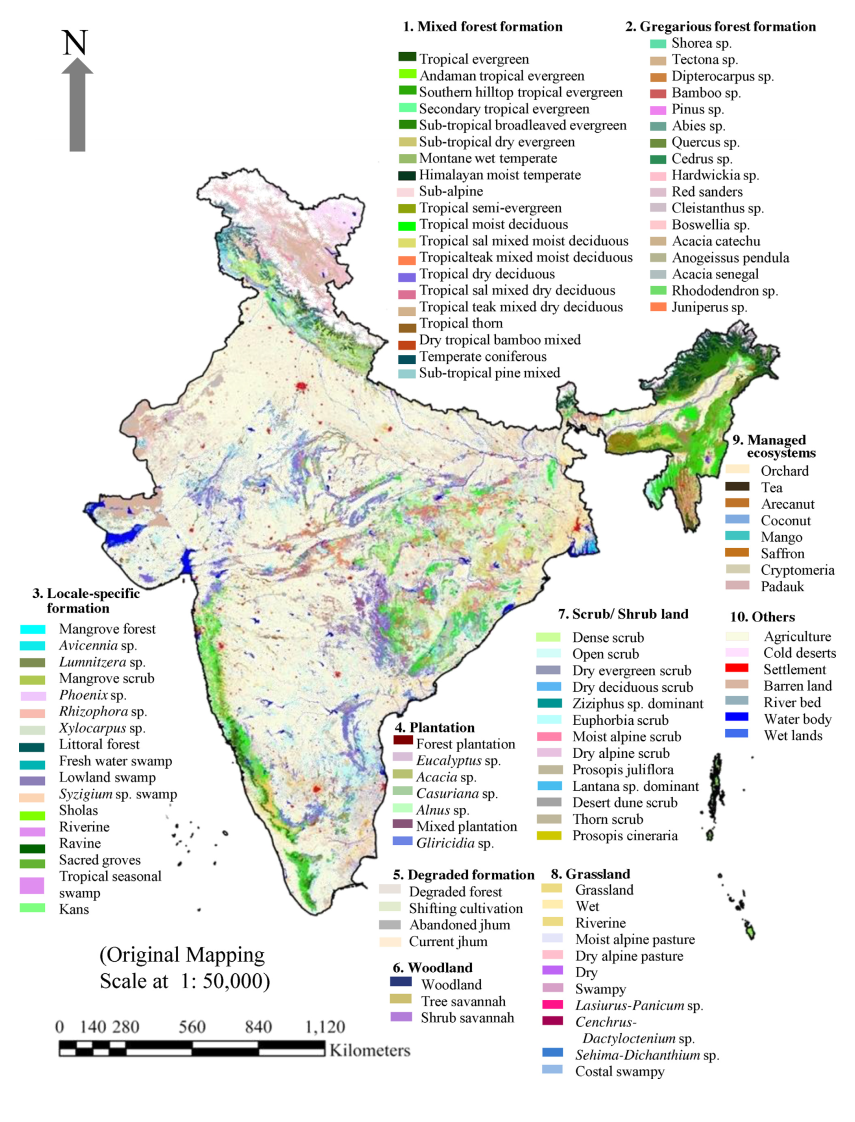
A number of now-classic vegetation type classifications (e.g., Champion and Seth 1968; Puri et al. 1983; Pascal 1986) have been attempted in the past for regions within India. In recognition of the fact that vegetation type classifications are periodically updated to reflect newly available information about plants and their environments, we follow the most recent classifications (Roy et al. 2015; Reddy et al. 2015) that are based on satellite data that have been ground-truthed and vetted by experts. India has numerous vegetation types resulting largely from the considerable heterogeneity in climate, soils, topography, and human land-use. For instance, in peninsular India, there exist the Western Ghats mountain range and the Eastern Ghats hill ranges bounding the Deccan Plateau. As a result, elevation ranges from sea level to over 2500 m above sea level (ASL). The Western Ghats significantly alter the climatic regime within India by serving as an orographic barrier to the rain-bearing southwest monsoon winds, resulting in a sharp precipitation gradient in the western side of the peninsula and bringing drier conditions to the rest of the peninsula. Similarly, the northern and eastern parts of India are bordered by the highest mountain chain in the world, the Himalaya, which exerts a tremendous influence on the climate, hydrology, and geomorphology of the subcontinent. Soils vary considerably as a consequence, particularly in response to topography, climate, and parent material. Finally, the remarkable biogeographic history of the Indian subcontinent has resulted in plants of numerous biogeographic affinities being present in most assemblages. Superimposed on this are the impacts of a diverse fauna including, notably, humans, who have occupied the region continuously for tens of thousands of years. |
Tropical evergreen forests, characterized by tall (> 30 m), often buttressed, evergreen trees, and multiple strata, are largely confined to the windward, high-precipitation zones (> about 2500 mm annually) of the Western Ghats, north-eastern India, and the Andaman and Nicobar Islands. In these densely packed plant communities, plant growth is limited not by water availability but by competition for light, resulting in a tall canopy. Tall and dense vegetation holds considerable carbon and thus tropical evergreen forests likely play an important role in regulating climate. As the precipitation decreases, so does the ratio of evergreen-to-deciduous plants. Many of these forests are species-rich, not just in plants but also animals and fungi, and are considered biodiversity ‘hotspots’. |
Tropical semi-evergreen forests, characterized by a predominance (> 75%) of evergreen trees, as well as climbers and epiphytes, are found in proximity to tropical evergreen and tropical moist deciduous forests (usually, but not always, in precipitation zones intermediate to the two). Like tropical evergreen forests, they too largely occur in the Western Ghats, northeastern India, and the Andaman and Nicobar Islands. |
Tropical moist deciduous forests are characterized by the dominance of drought-deciduous species, an irregular top storey and a lower storey dominated by evergreen trees and shrubs. These forests are widespread where the annual precipitation typically exceeds 1000 mm but is less than 2000 mm, in regions including the Western Ghats, northern Eastern Ghats, central and north-eastern India, and the Andaman and Nicobar Islands. They frequently grade into tropical semi-evergreen and tropical dry deciduous forests. Since plant growth is water-limited, many plants shed their leaves to minimize transpiration during the driest periods. Together with tropical dry deciduous forests, these forests are the most extensive forest type in the country. |
Tropical dry deciduous forests are characterized by intermediate (< 20 m), open canopies, consisting almost entirely of deciduous species that become leafless for 1-4 months, grasses, and frequent fires. These forests are found in large parts of peninsular India and the Himalayan foothills in the drier zones. They are sometimes dominated by teak (Tectona grandis) where they occur in southern, western, and central India and by sal (Shorea robusta) in northern, eastern, and central India. Teak-bearing forests are replaced by sal-bearing forests in central, northern, and eastern India in the 700 mm – 1500 mm annual precipitation zone (Gadgil and Meher-Homji 1986). Tropical dry deciduous forests — and even drier vegetation types consisting of tree-grass mixtures — that have historically been classified as forests are now often classified as savannas (Ratnam et al. 2016). |
Tropical thorn forests
are characterized by short (< 10 m), open canopies, consisting largely of thorny, leguminous (e.g., Vachellia, Senegalia, Prosopis), hard-wooded species, and sun-loving shrubs and grasses. These forests are found in the semi-arid and arid parts of peninsular, northern and north-western India, that receive < about 1000 mm precipitation annually. A number of moist and dry, sparse (< 10% canopy cover) scrub vegetation types consisting largely of evergreen or deciduous shrubs (including succulents) and stunted trees are distributed throughout in the arid and semi-arid parts of India, including northwestern hot deserts. |
Grasslands, characterized by the dominance of grasses and forbs, and the near absence of trees, are found both on hilltops and in plains throughout the country. Tree presence in grasslands may be limited by one or more factors, including climate (e.g., low precipitation, low temperatures), soil conditions (e.g., salinity, low soil depth, waterlogging), and the prevalence of fire and mammalian herbivory. Grasses are believed to have co-evolved with grazers, with one of the adaptations being greater investment in belowground organs. Thus, grasslands, which are more tolerant of fires than forests, tend to accumulate significant carbon stocks belowground (Retallack 2013). Major grassland types include coastal grasslands (found along coasts), riverine alluvial grasslands (found along banks of large rivers), montane grasslands (found in mountainous regions and including alpine meadows and steppe), sub-Himalayan tall grasslands of Terai (found at the convergence of Himalayan foothills and Gangetic plains), tropical savannas (found in central, western, and southern India; note that savannas, which are tree-grass mixtures, are often treated as a distinct vegetation type), and wet grasslands (found in waterlogged areas, usually close to water bodies) (Chandran 2015). |
Tropical dry evergreen forests, are relatively short (< 15 m), closed-canopied forests characterized by the dominance (> 75%) of hard-leaved evergreen woody plants (Parthasarathy et al. 2008). They are restricted to Coromandel Coast and the Eastern Ghats of Andhra Pradesh and Tamil Nadu in areas that receive most of their rain (> about 1000 mm annually) during the northeastern monsoon. |
Subtropical broad-leaved hill forests, characterized by a mixture of wet evergreen and temperate forest species, are found in the Western Ghats, north-eastern India, the Aravalli, and the lower slopes of the Himalaya where annual rainfall exceeds about 1000 mm. |
Subtropical pine forests are open-canopied, fire-prone forests dominated by evergreen conifers (needle-leaved) and grasses. They are found along the drier (often, but not always, south-facing) slopes at the lower elevations of the Himalayas and on hilly tracts of north-eastern India. |
Subtropical dry evergreen forests, characterized by small-leaved evergreen species, are found in the foothills of the Himalayas up to about 1500 m ASL with a prolonged dry season. |
Montane wet temperate forests are closed-canopied, broad-leaved evergreen forests characterized by relatively short (< 15 m) canopies, mosses, ferns, epiphytes and woody climbers. These forests are found in the wetter (annual precipitation up to about 4000 mm) and higher (> 1500 m ASL) elevations of the eastern Himalaya, north-eastern India, and the Western Ghats. In the Western Ghats, these forests are known as shola and are restricted to the Nilgiris, Palnis, Anamalais and Tirunelveli hills. These stunted forests are largely found in valleys and depressions amidst montane grasslands. |
Himalayan moist temperate forests are conifer-dominated and tall-canopied (up to 40 m) forests found throughout the Himalaya and hilly tracts of north-eastern India, from about 1500 m to 3000 m ASL. Himalayan dry temperate forests are sometimes distinguished as a distinct forest type (but see Singh and Singh 1987). Like their moist counterparts, dry temperate forests are also conifer-dominated, but have a high frequency of xerophytic shrubs and are found in relatively higher and drier (< 2000 mm annual precipitation) tracts of the Himalaya. |
Subalpine forests are conifer and rhododendron dominated, stunted and densely-branched, short-canopied (< 15 m) forests bearing numerous epiphytes (mosses, lichens). They occur beyond Himalayan temperate forests and up to the treeline, grading into alpine vegetation types such as alpine meadows. Rainfall is low and plants are mainly dependent on snowmelt for water. |
Littoral and swamp forests are evergreen-species dominated forests found where the soil is submerged in saline or fresh water, periodically or throughout the year. Pneumatophores, and stilt, knee, and buttress roots are common adaptations to the submerged conditions. Littoral and tidal swamp forests (which include mangrove scrub and mangrove forests) consist of halophytic (salt-tolerant) plants with seeds that germinate while still on the parent tree and are found in river deltas along the coastal regions of India, including the Andaman and Nicobar Islands. Mangrove forests have among the greatest per-unit-area biomass and carbon, most of it belowground (Pan et al. 2013). Freshwater swamp forests are found in waterlogged locations in the wet forests of southern Western Ghats, Eastern and Western Himalaya, and the Ganges and Brahmaputra valleys. |
Agricultural and non-agricultural human-dominated lands make up nearly 70% of India’s terrestrial area (Government of India 2025). The bulk of this is area is under agriculture (including tree crops), while the rest is dominated by settlements (including cities, towns and villages). Plant species in these lands are largely linked to anthropogenic requirements (food, fodder, fibre, raw materials, aesthetics, etc.) and are frequently non-native. While some species are mismatched to local environmental conditions and persist only through human intervention (e.g., irrigation), others are highly successful, even invasive. Despite the overwhelming influence of human agency on species composition, these lands continue to host many native species. Thus, on the one hand, vegetation in these lands is highly variable and locale dependent. On the other hand, there is a great degree of biotic homogenization–the replacement of native with wide-ranging non-native species (McKinney and Lockwood 1999)—resulting in similar vegetation across distant regions. |
A number of subtypes of these major vegetation types exist across the Indian subcontinent. The cited literature may be consulted for further details. |
Our evolving understanding of ecological restoration |
The past century or so has seen a shift in the dominant narrative of seeing nature as an unlimited, exploitable resource to that of requiring conservation, which includes both preservation and restoration. With this shift, the focus is now on the approaches to restoration that span a rather wide range: from tree-planting efforts focused on big numbers to careful selection of native species suited to the environment, from strong interventions such as invasive removal to allowing nature take its course. More recently, there is increasing recognition that indigenous humans have been an integral part of many ecosystems. Today there exists broad consensus on the principles of restoring ecosystems (i.e., plant, animal, fungal, microbial communities, and their physical environment) (Gann et al. 2019). These involve identifying reference models (often based on locations in nearby protected areas) that serve as targets for restoration activities. For vegetation, a reference model would provide information on target plant species, environmental conditions (soil, hydrology) and biotic factors (e.g., pollinators, seed dispersers) that would be present at a site once it is restored. |
References |
Bor NL (1960) The Grasses of Burma, Ceylon, India, and Pakistan, excluding Bambuseae. Oxford |
Champion HG, Seth SK (1968) A revised survey of the forest types of India. Govt. of India Press, New Delhi, India. |
Chandran M (2015) Grassland vegetation of India: An update. In: Rawat G, Adhikari B (eds) Ecology and management of grassland habitats in India. Wildlife Institute of India, Dehradun, India |
Charles-Dominique T, Davies TJ, Hempson GP, Bezeng BS, Daru BH, Kabongo RM, et al (2016) Spiny plants, mammal browsers, and the origin of African savannas. Proceedings of the National Academy of Sciences 113:E5572–E5579. https://doi.org/10.1073/pnas.1607493113 |
de Freitas GV, Da Cunha M, Vitória AP (2024) A systematic review of leaf and wood traits in the Neotropics: environmental gradients and functionality. Trees 38:551–572. https://doi.org/10.1007/s00468-024-02508-7 |
Gadgil M, Meher-Homji V (1986) Localities of great significance to conservation of India’s biological diversity. Proceedings of the Indian Academy of Science (Animal Science/Plant Science) Supplement 1986:165–180 |
Gann GD, McDonald T, Walder B, Aronson J, Nelson CR, Jonson J, et al (2019) International principles and standards for the practice of ecological restoration. Second edition. Restoration Ecology 27:S1–S46. https://doi.org/10.1111/rec.13035 |
Givnish TJ (2002) Adaptive significance of evergreen vs. deciduous leaves: solving the triple paradox. Silva Fennica 36:703–743 |
Government of India (2025) Land use statistics at a glance: 2023-2024. New Delhi, India |
Joswig JS, Wirth C, Schuman MC, Kattge J, Reu B, Wright IJ, et al (2022) Climatic and soil factors explain the two-dimensional spectrum of global plant trait variation. Nat Ecol Evol 6:36–50. https://doi.org/10.1038/s41559-021-01616-8 |
Jucker T, Fischer FJ, Chave J, Coomes DA, Caspersen J, Ali A, et al (2025) The global spectrum of tree crown architecture. Nat Commun 16:4876. https://doi.org/10.1038/s41467-025-60262-x |
Loucks C, Ricketts TH, Naidoo R, Lamoreux J, Hoekstra J (2008) Explaining the global pattern of protected area coverage: relative importance of vertebrate biodiversity, human activities and agricultural suitability. Journal of Biogeography 35:1337–1348. https://doi.org/10.1111/j.1365-2699.2008.01899.x |
Ma H, Crowther TW, Mo L, Maynard DS, Renner SS, van den Hoogen J, et al (2023) The global biogeography of tree leaf form and habit. Nat Plants 9:1795–1809. https://doi.org/10.1038/s41477-023-01543-5 |
McKinney ML, Lockwood JL (1999) Biotic homogenization: a few winners replacing many losers in the next mass extinction. Trends in Ecology & Evolution 14:450–453. https://doi.org/10.1016/S0169-5347(99)01679-1 |
Moles AT, Laffan SW, Keighery M, Dalrymple RL, Tindall ML, Chen S-C (2020) A hairy situation: Plant species in warm, sunny places are more likely to have pubescent leaves. Journal of Biogeography 47:1934–1944. https://doi.org/10.1111/jbi.13870 |
Pan Y, Birdsey RA, Phillips OL, Jackson RB (2013) The structure, distribution, and biomass of the world’s forests. Annual Review of Ecology, Evolution, and Systematics 44:593–622. https://doi.org/10.1146/annurev-ecolsys-110512-135914 |
Parthasarathy N, Selwyn MA, Udayakumar M (2008) Tropical dry evergreen forests of peninsular India: ecology and conservation significance. Tropical Conservation Science 1:89–110 |
Pascal J-P (1986) Explanatory booklet on the forest map of South India. Sheets: Belgaum-Dharwar-Panaji, Shimoga, Mercara-Mysore. Institut Français de Pondichéry. |
Pellegrini AFA, Anderegg WRL, Paine CET, Hoffmann WA, Kartzinel T, Rabin SS, et al (2017) Convergence of bark investment according to fire and climate structures ecosystem vulnerability to future change. Ecology Letters 20:307–316. https://doi.org/10.1111/ele.12725 |
Puri GS, Meher-Homji VM, Gupta RK, Puri S (1983) Forest Ecology. I - Phytogeography and forest conservation (Second). Oxford & IBH Publishing Co. Ltd., New Delhi, India. |
Ratnam J, Tomlinson KW, Rasquinha DN, Sankaran M (2016) Savannahs of Asia: antiquity, biogeography, and an uncertain future. Phil. Trans. R. Soc. B 371:20150305. https://doi.org/10.1098/rstb.2015.0305 |
Reddy CS, Jha CS, Diwakar PG, Dadhwal VK (2015) Nationwide classification of forest types of India using remote sensing and GIS. Environmental Monitoring and Assessment 187:777. https://doi.org/10.1007/s10661-015-4990-8 |
Retallack GJ (2013) Global cooling by grassland soils of the geological past and near future. Annual Review of Earth and Planetary Sciences 41:69–86. https://doi.org/10.1146/annurev-earth-050212-124001 |
Roy PS, Behera MD, Murthy MSR, Roy A, Singh S, Kushwaha SPS, et al (2015) New vegetation type map of India prepared using satellite remote sensing: Comparison with global vegetation maps and utilities. International Journal of Applied Earth Observation and Geoinformation 39:142–159. https://doi.org/10.1016/j.jag.2015.03.003 |
Sandel B, Svenning J-C (2013) Human impacts drive a global topographic signature in tree cover. Nature Communications 4:2474. https://doi.org/10.1038/ncomms3474 |
Singh JS, Singh SP (1987) Forest vegetation of the Himalaya. Botanical Review 53:80–192 |

The Center for Ecological Sciences (CES), Indian Institute of Science houses a herbarium of a fairly large number of specimens of native and naturalized plants collected by many taxonomists and researchers. This herbarium is recognized internationally by the acronym ‘JCB’. The collection consists of more than 20,000 specimens, from vascular plants to lichens. The duplicates of the authenticated specimens have been deposited with herbaria of the Royal Botanic Gardens at KEW, UK and the Smithsonian Institution, Washington DC, USA. It is richest with plants from the state of Karnataka and the Western Ghats. Recent efforts have added further collection from other states in the country. This herbarium probably is the only holding of plant specimens collected from all over India other than the Central National Herbarium (CAL).
One important research activity in the herbarium has been to generate and organize vast amounts of information on the floral wealth of different regions of the country and then package it to suit the requirements of online information systems.
Further to launching the Digital flora of Karnataka, Digital flora of Eastern Ghats, Flora of Peninsular India and India Flora Online databases, the herbarium team has embarked on developing an online information system for the tree diversity in the country.
K. Sankara Rao,
Herbarium JCB,
Centre for Ecological Sciences (CES),
Indian Institute of Science (IISc),
Bangalore - 560012.
Phone: +91 80 22932506;
+91 80 23600985
E-mail: herbarium.ces@iisc.ac.in;
shankarrao@iisc.ac.in
How to upload contributions:
Share field images via links (Google Drive, One Drive or others)
shankarrao@iisc.ac.in
 As observations of vegetation have accumulated globally over time, our understanding of vegetation structure and change also has also evolved. For instance, it was once commonly believed that the vegetation in a given set of climatic and edaphic (soil) conditions would, in the absence of human intervention—such as human-set fires, livestock grazing, and logging—inevitably progress towards a single type—at least in physiognomy, if not traits and floristic composition—called the climatic-edaphic ‘climax’. In this view, most grasslands and savannas in India were thought to be degraded stages of forests, arrested by anthropogenic pressures from progressing towards the climatic climax for the location (Bor 1960; Champion and Seth 1968). Indeed, globally, climate and soil do appear to be the primary drivers of plant traits and, by extension, vegetation physiognomy (Joswig et al. 2022). However, we now understand that a single climatic/edaphic regime can support alternative vegetation types, even physiognomically distinct ones such as forest and savanna, even in the absence of human influence. Examples of non-human factors that can determine which vegetation types are present within a single climatic/edaphic regime are natural fire, herbivory, and the small-scale environmental conditions, such as microclimate, created by the vegetation itself. Such factors can result in a mosaic of vegetation types being present within a climatic/edaphic regime and can also cause periodic switches between vegetation types. We also now recognize that plant communities are rather dynamic–exhibiting large abundance fluctuations and even species composition changes at both short (yearly to decadal) and long (centennial and millennial) timescales.